The web page would like to load the following external sources:
These are not loaded for data protection reasons! Activate JavaScript if you want to load this content. You only see the local content.
CRC/SFB 1573 "4f for Future"
Welcome to the website of the Collaborative Research Centre (CRC) 1573 "4f for Future". CRC 1573 is funded by the German Research Foundation (DFG) and has officially been launched on January 1st, 2023, cf. press releases from DFG and KIT. It is coordinated by Karlsruhe Institute of Technology (KIT), its current partners are Heinrich Heine University Düsseldorf (HHU, since 10/2023), the University of Tübingen (UTÜ) and Johannes Gutenberg University Mainz (JGU, since 08/2024).
Materials based on rare-earth metals and their compounds are of crucial importance to our modern high-tech society. Surprisingly, the molecular chemistry of these elements is poorly developed. However, recent progress in this area has shown that this is going to change: In the past years, dynamic developments in the chemistry and physics of molecular rare earth compounds have shifted borders and paradigms that existed for decades.
The chemistry of molecular and nanoscaled rare-earth compounds and their physical properties are in the focus of our CRC “4f for Future”. Its researchers study synthesis paths and physical properties of new molecular and nanoscaled rare-earth compounds in order to develop materials with unprecedented optical and magnetic properties.
Find out more about the individual research projects here.

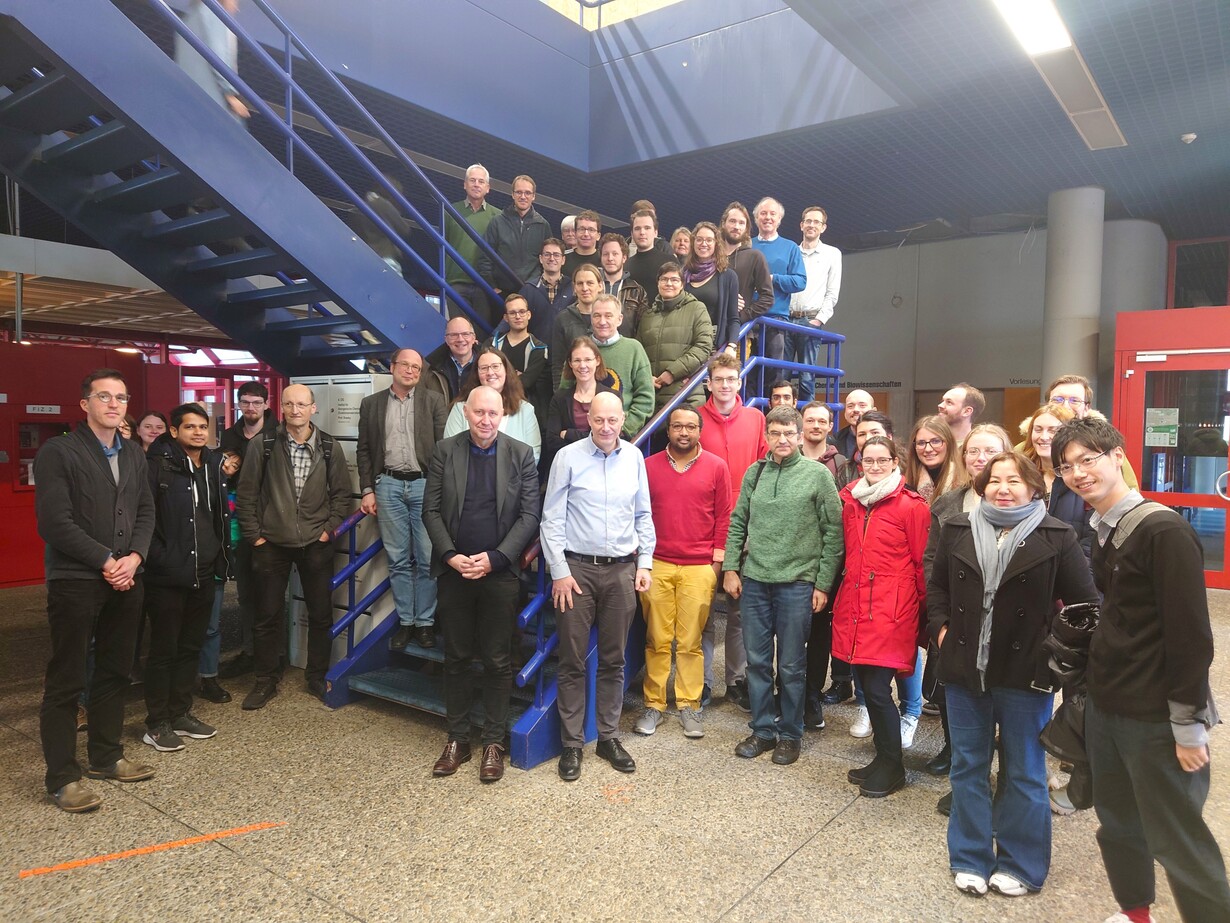
On October 5-7, 2026, "4f for Future" held their annual CRC Fall Workshop in Rastatt/Germany. Project presentations by all PIs involved as well as research posters by the doctoral researchers were accompanied by many fruitful discussions which helped further strengthening the excellent scientific network.
Tutorials presented by the workshop chairs Prof. Tonya Vitova (KIT) & Prof. Michael Seitz (University of Tübingen) and a soft-skill course by Dr. Lisa Andergassen (KEPOS), giving a variety of useful tips for applying for jobs in industry, rounded off the successful event.

Congratulations to our PI Schirin Hanf who has just been awarded the 2026 Wöhler-BASF Young Scientist Award. This prestigious biennial award honours researchers who have completed their doctorates for outstanding, independent scientific work carried out within the first six years after the start of independent research in inorganic molecular chemistry.
In her acceptance speech, Dr. Hanf said "a big thank you to the Wöhler Association and BASF for this recognition and, most importantly, to my wonderful research group. This award reflects our shared work, ideas, discussions, and enthusiasm for chemistry."
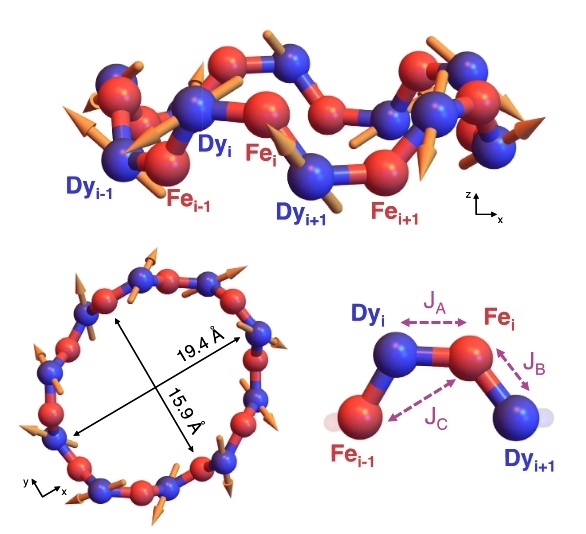
Toroidal magnetic states are difficult to prepare and detect in molecules. Recent results of an analysis of the magnetic behavior within a toroidic ring of alternating Dy/Fe carried out by the 4f4f groups of PIs Annie K. Powell and Wolfgang Wernsdorfer, in collaboration with researchers from Italy and Australia, confirmed a solenoidal toroic behavior: the authors showed that near-infrared light can drive finite-temperature toroidal polarization in a Dy/Fe molecular ring, enabling magnetoelectric readout.
The corresponding paper published in Nature Communications (Nat. Commun. 2026, 17, 9030) was highlighted by the journal editors.

With its CZS Nexus funding program, the prestigious Carl Zeiss Foundation supports the academic career development of outstanding young scientists by giving them the opportunity to establish their own junior research groups.
Congratulations go to our new CRC project leader Dr. Bianca Schacherl (INE, KIT) who is one of the carefully selected awardees: in her Bio-ALMS (Biological interactions of Actinides and Lanthanides deciphered through combined Microscopy and Spectroscopy) project, she is working on a new approach for more detailed analyses of the interactions of radioactive elements in biological samples.
Working with her interdisciplinary research team, she uses modern x-ray techniques that simultaneously collect and link spatial, chemical, and biological information for the first time. “With Bio-ALMS, we’re developing multiple spectromicroscopic platforms that we can use to examine cells down to the nanometer level,” Schacherl explains, "these innovative methods promise applications beyond nuclear medicine and toxicology, from personalized cancer treatment to environmental and materials research.”
More information can be found here, and in this short video clip Bianca talks about her spectromicroscopic Bio-ALMS research.

Congratulations once again: on the occasion of the upcoming 12th International Conference on f-Elements (ICfE-12) at The University of Manchester/UK our project leader Dr. Bianca Schacherl (INE, KIT) will receive the ERES Junior Award 2026 from the European Rare Earth and Actinide Society (ERES) "for her outstanding contributions to f-element X-ray spectroscopy and spectromicroscopy".

Congratulations to our CRC members Dr. Lucy Mottram (left) and her group leader Dr. Bianca Schacherl of the Development of X-ray Spectroscopies and Radiochemical Applications group in INE's "Advanced X-ray Spectroscopy in f-element Chemistry" department at KIT.
Both researchers received the best oral presentation awards at the 19th international conference on X-ray absorption fine structure (XAFS 2026), which took place from June 21 to 26, 2026, in Chiang Mai, Thailand.

On the occasion of KIT's "Campustag 2026" on June 13, 2026, an event addressing a young school-age target audience by presenting the unique opportunity to get to know KIT in all its exciting and colorful facets for their choice of future studies, "4f for Future" project leader Prof. Claus Feldmann gave a fascinating one-hour taster lecture:
"Die Zwerge kommen: Chemie und Eigenschaften von Nanomaterialien" ("Arrival of the Dwarves: The Chemistry and Properties of Nanomaterials") presented scientific results achieved in the CRC projects A4 and C4.

Congratulations to our project leader Prof. Dr. Alexander Hinz (A5) who received a call for a Heisenberg professorship to the University of Jena which he has accepted. Since June 1, 2026, he is now W3 Heisenberg Professor for Inorganic Molecular Chemistry at Friedrich Schiller University Jena.
He and his research group continue their work on reactive molecular compounds there, using sterically demanding ligands to stabilize unusual structural motifs, drawing on elements from across the entire periodic table, and investigating reactivity, including catalysis, as well as specific spectroscopic properties.
By clicking on the button below, data is loaded from the following external servers:
Personal data (e.g. your IP address) is transmitted to these external servers.
The web page would like to load the following external sources:
These are not loaded for data protection reasons! Activate JavaScript if you want to load this content. You only see the local content.
Der Sonderforschungsbereich SFB 1573 "4f for Future" befasst sich mit der Chemie molekularer und nanoskaliger Verbindungen der Seltenen Erden sowie ihren physikalischen Eigenschaften.
Diese Webseite ist nur in englischer Sprache verfügbar. Für deutschsprachige Informationen wenden Sie sich bitte an webmaster∂sfb1573.kit.edu.
